
Why Is My Solar Battery Not Charging? 10 Common Causes and Solutions
Is your solar battery not charging properly? A poorly charging battery can reduce backup time, lower system efficiency, and increase electricity costs. In this comprehensive guide, SK Luminous explains the 10 most common causes of solar battery charging problems, including faulty solar panels, charge controller issues, damaged wiring, battery aging, and inverter faults. Learn practical troubleshooting steps, maintenance tips, and expert solutions to keep your solar power system running efficiently. Whether you have a residential, commercial, or industrial solar installation, this guide will help you identify problems quickly and maximize your system's performance.
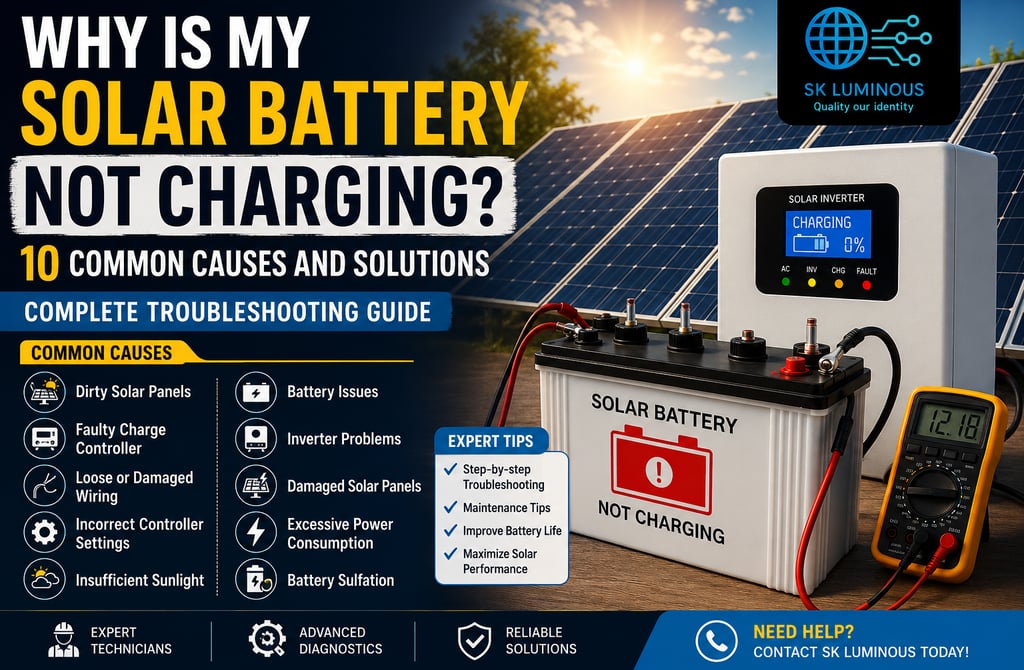
Complete Solar System Troubleshooting Guide by SK Luminous
A solar power system is designed to provide reliable, clean, and cost-effective electricity. However, one of the most common problems faced by homeowners and businesses is a solar battery that suddenly stops charging or charges very slowly. When this happens, the entire solar system's performance is affected, leading to reduced backup time, lower efficiency, and increased electricity costs.
If your solar battery is not charging properly, don't panic. In most cases, the issue can be identified and resolved through systematic troubleshooting. This comprehensive guide from SK Luminous explains the most common reasons why a solar battery may not be charging and provides practical solutions to help restore your system's performance.
Understanding How Solar Battery Charging Works
Before troubleshooting, it is important to understand the basic charging process.
A typical solar power system consists of:
Solar Panels
Charge Controller (MPPT or PWM)
Battery Bank
Solar Inverter
Protection Devices and Wiring
The solar panels generate DC electricity from sunlight. This electricity passes through the charge controller, which regulates voltage and current before charging the battery. The inverter then converts stored DC power into AC power for household or commercial use.
A problem in any part of this chain can prevent the battery from charging properly.
Signs That Your Solar Battery Is Not Charging
Some common symptoms include:
Battery percentage remains unchanged throughout the day.
Inverter displays battery charging errors.
Backup time has decreased significantly.
Battery voltage remains low despite sunny weather.
Solar panels are generating power, but battery level is not increasing.
Inverter switches to grid power frequently.
Battery charging current appears extremely low.
If you notice any of these signs, immediate inspection is recommended.
Schema FAQ Questions
Q1
Why is my solar battery not charging?
Q2
How do I test a solar battery?
Q3
Can a faulty inverter stop battery charging?
Q4
Can dirty solar panels affect battery charging?
Q5
How often should a solar system be serviced?
Cause #1: Insufficient Sunlight Reaching Solar Panels
The most common reason for charging issues is inadequate solar energy production.
Solar panels require direct sunlight to generate maximum output. Factors such as cloudy weather, shading, dust, dirt, bird droppings, and nearby buildings can significantly reduce solar production.
How to Check
Inspect panels for dirt and debris.
Check for tree shadows during peak sunlight hours.
Monitor daily solar production through the inverter display.
Compare current production with previous performance records.
Solution
Clean solar panels regularly.
Trim nearby trees.
Remove obstructions.
Install panels in an optimal orientation.
Regular cleaning alone can improve output by 10% to 25% in dusty environments.
Cause #2: Dirty Solar Panels
Dust accumulation is particularly common in regions with dry climates and heavy traffic pollution.
When dirt covers the solar cells, sunlight cannot reach the photovoltaic surface effectively.
Common Indicators
Reduced solar generation.
Uneven panel appearance.
Visible dust layers.
Frequent low charging alerts.
Solution
Clean panels using:
Soft brush
Clean water
Microfiber cloth
Avoid:
Harsh chemicals
Pressure washers
Abrasive cleaning materials
Professional solar cleaning every few months can significantly improve charging efficiency.
Cause #3: Faulty Charge Controller
The charge controller is responsible for regulating battery charging.
If the controller fails, the battery may receive insufficient charging current or no charging current at all.
Symptoms
Controller display is blank.
Battery voltage remains unchanged.
Error messages appear.
Charging current shows zero.
How to Test
Measure panel voltage at the controller input.
Measure controller output voltage.
Compare readings with manufacturer specifications.
Solution
Reset controller settings.
Check firmware updates.
Replace damaged controllers.
Verify wiring connections.
MPPT controllers generally offer better performance than PWM controllers, especially in larger systems.
Cause #4: Loose or Damaged Wiring
Solar systems operate outdoors and are exposed to heat, moisture, and environmental stress.
Over time, electrical connections may loosen or corrode.
Common Problems
Loose terminals
Burned connectors
Corroded battery terminals
Damaged MC4 connectors
Symptoms
Intermittent charging
Voltage fluctuations
Heating at connection points
Sparks or burning smell
Solution
Inspect:
Battery terminals
Solar panel connectors
DC breakers
Charge controller terminals
Tighten connections and replace damaged cables immediately.
Cause #5: Battery Has Reached End of Life
All batteries have a limited lifespan.
Typical lifespans:
Lead Acid Battery: 3–5 years
Tubular Battery: 5–8 years
Lithium Battery: 8–15 years
As batteries age, their ability to accept and store charge decreases.
Symptoms
Rapid discharge
Poor backup time
Low charging acceptance
Swollen battery casing
Testing Procedure
Measure battery voltage after a full charge.
Perform a load test to determine actual capacity.
Solution
Replace batteries that fail capacity tests.
Upgrading to lithium batteries can improve efficiency and lifespan.
Cause #6: Incorrect Charge Controller Settings
Improper charging parameters can prevent batteries from charging correctly.
Many systems are installed with default settings that do not match battery specifications.
Common Mistakes
Wrong battery type selected
Incorrect charging voltage
Improper float voltage
Incorrect battery capacity settings
Solution
Verify:
Battery chemistry
Charging voltage requirements
Controller programming
Always follow manufacturer recommendations.
Cause #7: Solar Panels Are Damaged
Solar panels are durable but can suffer damage due to:
Hailstorms
Falling objects
Manufacturing defects
Hot spots
Micro-cracks
Symptoms
Reduced voltage output
Lower current generation
Physical cracks
Burn marks
Testing
Use a multimeter to check:
Open Circuit Voltage (Voc)
Short Circuit Current (Isc)
Compare readings with panel specifications.
Solution
Replace severely damaged panels.
Professional thermal imaging can identify hidden defects.
Cause #8: Battery Sulfation
Battery sulfation is common in lead-acid batteries.
It occurs when batteries remain partially discharged for extended periods.
Sulfate crystals accumulate on battery plates, reducing charging efficiency.
Symptoms
Low capacity
Extended charging times
High internal resistance
Prevention
Avoid deep discharges.
Maintain regular charging cycles.
Use quality charge controllers.
Solution
Early-stage sulfation may be reversed using equalization charging.
Severe sulfation often requires battery replacement.
Cause #9: Excessive Power Consumption
Sometimes the battery appears not to charge because the connected loads consume power faster than the solar system can generate it.
Examples
Air conditioners
Electric heaters
Water pumps
Industrial machinery
Symptoms
Battery percentage remains stagnant.
Charging current appears normal.
Load current exceeds charging current.
Solution
Calculate total daily energy consumption.
Reduce unnecessary loads during charging periods.
Upgrade system size if required.
Cause #10: Inverter Malfunction
The inverter plays a critical role in energy management.
Certain inverter faults can interfere with battery charging.
Common Faults
Charging circuit failure
Software errors
Internal relay faults
Communication issues
Symptoms
Error codes
Unexpected shutdowns
Battery charging interruptions
Solution
Review error logs.
Update firmware.
Contact technical support.
Replace faulty components.
How to Test a Solar Battery with a Multimeter
A digital multimeter is one of the most useful diagnostic tools.
Step 1
Turn off major loads.
Step 2
Measure battery voltage.
Typical readings:
12V Battery:
Fully Charged: 12.7V–13V
50% Charged: 12.2V
Discharged: Below 11.8V
24V Battery:
Fully Charged: 25.4V–26V
48V Battery:
Fully Charged: 50.8V–52V
Step 3
Measure charging voltage during sunlight.
If charging voltage remains below specifications, further investigation is required.
Preventive Maintenance Tips
Regular maintenance helps avoid charging problems.
Monthly
Inspect wiring.
Clean solar panels.
Check battery terminals.
Review inverter alerts.
Quarterly
Test battery voltage.
Verify controller settings.
Inspect protection devices.
Annually
Professional inspection.
Thermal scanning.
Capacity testing.
Performance evaluation.
When to Call a Professional
Contact a qualified solar technician if:
Battery voltage remains low despite good sunlight.
You notice burning smells.
Wiring damage is visible.
Inverter displays persistent faults.
Battery swelling occurs.
Solar generation drops unexpectedly.
Professional diagnosis can prevent expensive system failures and extend equipment life.
Why Choose SK Luminous for Solar Troubleshooting?
SK Luminous provides professional solar services for residential, commercial, and industrial customers.
Our services include:
Solar system diagnostics
Solar panel testing
Battery health assessment
MPPT and PWM controller troubleshooting
Inverter repair and configuration
Preventive maintenance programs
Hybrid and off-grid solar support
Industrial solar inspections
Our experienced technical team uses advanced testing equipment to identify issues quickly and restore system performance efficiently.
Conclusion
A solar battery that is not charging can result from various issues, including insufficient sunlight, dirty panels, faulty charge controllers, damaged wiring, aging batteries, incorrect settings, excessive loads, or inverter failures.
Fortunately, most charging problems can be diagnosed through systematic troubleshooting and routine maintenance. By understanding the causes and implementing the solutions discussed in this guide, solar system owners can maximize performance, improve reliability, and extend equipment lifespan.
Regular inspections, proper maintenance, and timely repairs are essential for keeping your solar power system operating at peak efficiency. If you are experiencing charging problems or require professional assistance, SK Luminous is ready to help with expert solar troubleshooting and maintenance services.
#SolarBattery
#SolarEnergy
#SolarPower
#SolarTroubleshooting
#SolarMaintenance
#SolarPanels
#RenewableEnergy
#SolarRepair
#SolarInverter
#GreenEnergy
#SKLuminous
#SolarPakistan
#CleanEnergy
#SolarSolutions
why is my solar battery not charging
how to fix solar battery charging problems
solar battery not charging during daytime
solar inverter charging battery slowly
common solar system faults and solutions
how to test solar battery with multimeter
solar panel producing low voltage
solar battery charging troubleshooting guide
solar maintenance checklist for homeowners
solar battery charging issues and solutions
Services
All Types Of Engineering Services
Contact@skluminos.com
+923138136089
© 2026. All rights reserved SK Luminous